

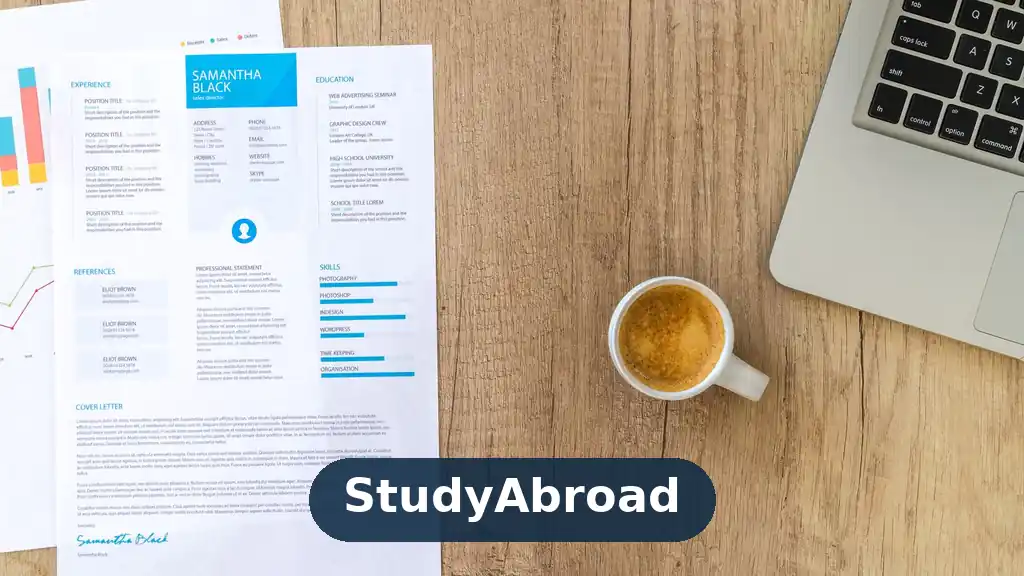
A CV for a university application, often called a resume in the United States, is a short document that summarises your education, your experience and your skills for an admissions team. It is not a job application, it is not a life story, and it is not a place to repeat your statement of purpose in list form. Its job is to give the reader a clear, honest picture of what you have done and what you can do, in a format they can scan in a minute and read in detail if they want to. This guide explains how a university CV differs from a job resume, gives you a structure that works, and shows you how to present projects, work and skills with evidence rather than empty claims.
One note before you start. This guide gives you structure and example outlines for each section, not a copied full template presented as a real person document. Your CV must be your own record, written in your own words, with your own education and experience. A copied template tells an admissions team nothing about you, and it often includes experience that does not match the rest of your application. Use the structure here, fill it with your own history, and keep every claim true and checkable. If you are building your whole application, start with our how to apply to universities abroad step by step guide and keep your documents in our university application documents checklist.
What a University Application CV Is
A university application CV is usually one to two pages long, and it lists your education, your research or project experience, your work experience, your skills and your achievements, in reverse chronological order, with the most recent first. Admissions teams use it to check your academic background, to see what experience you bring, and to judge whether you are ready for the programme. They read it alongside your transcripts, your statement of purpose and your recommendation letters, so it should agree with those documents and add detail they do not contain, rather than contradicting them or repeating them word for word.
How a CV Differs From a Job Resume
A job resume is written to win an interview for a specific role, and it emphasises work experience, achievements and skills that match the job description. A university CV is written to show academic readiness, and it emphasises education, research, projects, and the skills that matter for study, such as independent research, writing, data analysis and teamwork. Work experience still matters, especially for professional programmes, but it is presented in terms of what you learned and how it relates to your studies, not only in terms of what you produced for an employer.
Structure That Works
A reliable structure for a university CV has six parts. The header gives your full name, your email address, your phone number and your location, and optionally a link to a professional profile or a portfolio if it is relevant. The education section lists your degrees and qualifications in reverse order, with the institution, the dates, the subject and your grade or expected grade. The experience section covers research, projects, internships and work, with a short description of each role and what you achieved. The skills section lists languages, technical skills and other abilities that are relevant to the programme. The achievements section covers awards, scholarships and publications, and the final section covers interests or additional information, kept short and relevant.
Writing the Education Section
The education section is the most important part of a university CV, so write it carefully. For each qualification, give the institution name, the location, the dates you attended, the degree or qualification name, the subject, and your grade or expected grade. If your grade system is unfamiliar to the admissions team, give a short explanation, such as your grade point average on its scale, your class rank, or a note that your university does not rank students. Add relevant coursework only if it is directly relevant to the programme, and keep the list short, with four or five courses at most, rather than a full transcript.
If you completed a final year project, a dissertation or a thesis, include its title and a one line description, because it shows the admissions team what you can do independently. If you took additional courses, online or in person, that are relevant to the programme, you can list them briefly, but do not pad the section with courses that have no connection to your application. Keep dates consistent with your transcripts and with your statement of purpose, because a mismatch in dates or grades will raise questions. Check the spelling of every institution and qualification name, and use the official English name where one exists.
Presenting Experience Projects and Skills
Experience entries work best when each one follows a simple pattern, which is what you did, how you did it, and what the result was. Start each bullet point with a strong verb, such as designed, analysed, coordinated, researched or presented, and give a specific detail, such as the size of a team, the tool you used, or the outcome of the work. A bullet point that says you analysed survey data from two hundred respondents using a spreadsheet and presented the findings to your class tells the reader far more than a bullet point that says you have strong analytical skills. One or two well written bullet points per role are enough, and three is the most you should use for any single entry.
Formatting and Length
Keep your CV to one page if you are applying for an undergraduate degree or a taught master with limited experience, and to two pages at most for a postgraduate or research application with substantial experience. Use a standard font, a font size between ten and twelve points for the body, and clear headings that stand out without being decorative. Keep margins consistent, use the same date format throughout, and use bullet points rather than long paragraphs, because bullet points are easier to scan. Save the file as a PDF unless the university asks for another format, and name the file clearly, such as your name followed by CV, so the admissions team can find it easily.
CV Mistakes That Weaken an Application
Several mistakes weaken a university CV, and all of them are easy to avoid. The first is exaggeration, which means claiming a skill, a grade or a role you do not have, because a single invented claim can end an application if it is discovered. The second is padding, which means filling the CV with irrelevant jobs, hobbies or courses to make it look longer, because admissions teams can tell the difference between relevant experience and filler. The third is vagueness, which means writing bullet points that say you were responsible for something without saying what you actually did. The fourth is inconsistency, which means dates, grades or job titles that do not match your transcripts or your statement.
Other mistakes are smaller but still costly. Including a photo, your date of birth, or personal details that the university does not ask for can create problems, so check the university guidance on what to include. Using an unprofessional email address, or an email address you rarely check, can mean you miss a message from the university. Copying a template and leaving in experience that is not yours is dishonest and easy to spot. And submitting a CV that is too long, too dense, or badly formatted makes it harder for the admissions team to find the information they need. For other application pitfalls, see our guide on common university application mistakes to avoid.
Conclusion
A strong CV for a university application is clear, honest and focused on what matters for the programme. Start with your education, present your experience and projects with specific evidence, list your skills honestly, and keep the document to one or two pages with clean, consistent formatting. Tailor the CV to each programme by giving more space to the experience that is most relevant, and check that it agrees with your transcripts, your statement and your recommendation letters. If you do that, your CV will do what it is meant to do, which is to help the admissions team see, at a glance, that you are ready for the degree and that you will make good use of the opportunity to study abroad.
How long should a CV for university applications be?
One page is enough for most undergraduate and taught master applications, and two pages is the maximum for postgraduate or research applications with substantial experience. Keep the document focused on education, relevant experience, projects and skills. A shorter CV that is clear and honest is stronger than a longer one filled with irrelevant detail.
What should I include in a university application CV?
Include a header with your contact details, an education section with institutions, dates and grades, an experience section covering research, projects, internships and work, a skills section, and an achievements section for awards and publications. Keep each entry specific, with what you did, how you did it and what the result was.
Should I include a photo on my university CV?
Usually no, unless the university or the country specifically asks for one. Most universities do not want a photo, your date of birth or other personal details on a CV. Check the university guidance for the programme you are applying to, and follow it. Use a professional email address that you check regularly.
How is a university CV different from a job resume?
A university CV emphasises education, research, projects and academic skills, while a job resume emphasises work experience matched to a specific role. A university CV can include research, publications, academic awards and relevant coursework, and it can describe a project in slightly more detail. Keep the education section near the top, because that is what admissions teams look for first.